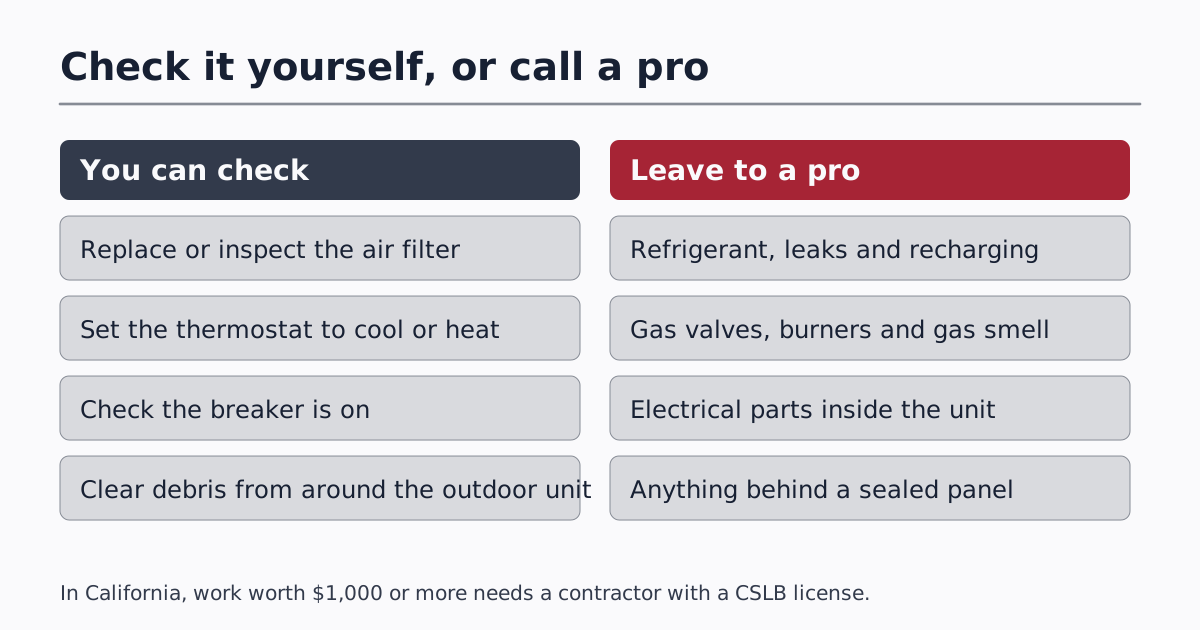
Repairing a gas furnace is a split job. You can check the thermostat, the filter and the breaker. Everything that touches gas, the burner, the venting or the control board belongs to a specialist. Fixr's furnace repair guide puts a typical repair in the hundreds of dollars, and the details are in the cost section below. For the bigger picture, including when replacing makes more sense, see furnace repair and replacement.
Modesto winters are mild next to much of the country, with a January average high of about 56 F and low near 39 F per Climates to Travel (1991 to 2020), so a gas furnace may sit idle for months. That is why many failures show up on the first cold morning of the season, when the system has to run for the first time since last winter.
Why does my gas furnace not heat or light?
Most gas furnaces fail to heat because one step in the ignition sequence stops. The inducer motor starts, a pressure switch confirms airflow, the igniter glows, the gas valve opens, the flame lights and the blower follows. A break anywhere in that chain leaves you with cold air or no air at all.
Industry troubleshooting guides and furnace manuals describe these common patterns:
- No igniter glow: the igniter or the pressure switch is the usual suspect.
- Igniter glows, no flame: points to the gas supply or the gas valve.
- Flame lights, then dies in seconds: often a dirty flame sensor.
- Repeated tries, then nothing: many furnaces lock out after a few failed ignition tries and flash a code; check the manual for the count.
- High-efficiency models: a clogged condensate drain line or trap can hold the pressure switch open and stop the sequence.
Those are patterns, not a diagnosis. Two different faults can look the same from the living room, which is why a specialist reads the flash code and tests the part before replacing anything.
What can I check myself before I call anyone?
Check the thermostat, the filter, the power and the vents, and stop there. These checks are safe, free and solve a surprising share of "no heat" calls. Nothing on this list involves opening the furnace or touching gas.
- Thermostat: set to heat, set a few degrees above room temperature, and replace its batteries if it has them.
- Filter: a clogged filter restricts airflow and can make the furnace overheat and shut down as a safety step. The filter guide on this site explains how to change a furnace filter step by step.
- Power: the furnace has its own switch near the unit and a breaker in your panel. Make sure neither was knocked off.
- Vents and returns: open and unblocked, with furniture and rugs clear of them.
- Condensate drain line: on high-efficiency furnaces, see whether water is backing up or leaking near the unit. Report this to the specialist rather than digging into it.
If the furnace restarts after these checks, note what you changed. If it shuts off again within a day or two, the cause is something these steps cannot reach.
What should never be a DIY repair on a gas furnace?
Leave the gas valve, gas supply, burners, heat exchanger, venting, pressure switch, inducer motor and control board to a specialist. In California, work with $1,000 or more in labor and materials needs a contractor who holds a CSLB license, and the C-20 classification covers warm-air heating systems. Check any contractor at cslb.ca.gov before work starts.
Why the line is firm:
- Carbon monoxide. The CPSC warns that furnaces can cause carbon monoxide poisoning if they are improperly installed, poorly maintained, or have defective or blocked venting. Early symptoms can resemble the flu without a fever.
- Gas. A smell of gas is not a repair problem. It is a reason to leave the house and call emergency services or your gas utility. This site does not give step-by-step gas-leak instructions because they belong to the utility.
- Warranty and permits. Replacement parts and furnace change-outs can involve permits and manufacturer warranty terms. Ask before any work starts.
Put a battery-operated or battery-backup CO alarm on every level and outside sleeping areas, and test the alarms as the manufacturer directs. If it sounds, go outside to fresh air and call 911. Do not go back in to find the source.
How much does it cost to repair a gas furnace?
Fixr's furnace repair guide (updated August 2025) lists a typical range of $349 to $650. These are national figures, not Modesto prices, and your final quote depends on the part, the furnace model and the time needed.
| Repair | Published range (national) |
|---|---|
| Flame sensor | $68 to $127 |
| Igniter | $96 to $178 |
| Limit switch | $66 to $122 |
| Control board | $390 to $725 |
| Blower motor | $562 to $1,045 |
| Heat exchanger | $1,346 to $2,673 |
Source: Fixr furnace repair guide (August 2025). Labor rates on that page run $87 to $162 per hour, and an emergency visit often adds a surcharge. A service call fee, which Fixr lists at $75 to $250, is often applied to the repair if you hire the same company.
Cost pages on this site go further: see furnace ignitor replacement cost and furnace replacement cost if the quote is climbing.
When is a repair not worth it?
A repair stops making sense when it costs about half the price of a new furnace, or when the furnace is already old. Carrier's lifespan table lists 15 to 20 years for furnaces and it suggests considering replacement after about 15 years, especially with frequent repairs or rising energy bills.
Two rules of thumb are common, though neither comes from a manufacturer. One says to replace when the repair costs more than 50% of a new system (Carrier says costs that approach 50 percent point toward replacement). The other, a common rule of thumb called the "5,000 rule," multiplies the repair cost by the furnace's age in years, and a result above 5,000 favors replacement. A $600 repair on a 10-year-old furnace scores 6,000, for example. Both are guides, not laws.
Fixr's furnace replacement page puts the average new furnace near $4,800 installed, with a typical range of $2,800 to $7,500 and gas models at $3,800 to $10,000. A heat exchanger crack, or a safety lockout that keeps returning, tips the numbers fastest. If you are also thinking about switching fuel, read furnace vs heat pump first.
How do I get a repair quote?
Describe the symptom, the age of the furnace and any flash code on the control board, then ask for a written quote that splits the diagnostic fee from the repair. Check each one's CSLB license yourself.
Collect two quotes if the repair is more than a simple part. Ask whether the diagnostic fee comes off the repair, whether the part carries a warranty, and whether the visit includes a safety check of the venting.
To start, use the price request form. The home page lists the other heating and cooling topics and the nearby towns.
Questions people ask
How long does it take to repair a gas furnace?
A simple part like a flame sensor or igniter can often be done in one visit of an hour or two, if the specialist has the part on the truck. A control board, blower motor or heat exchanger may need a second visit or a part order. Ask for an estimated timeline in the written quote.
What should I ask before I hire someone to repair a gas furnace?
Ask for the CSLB license number and check it at cslb.ca.gov, ask for a written quote with the diagnostic fee separate, and ask what the part warranty covers. Also ask whether they will check the venting and test for carbon monoxide after the repair, and whether a permit applies.
Do I need to be home for a gas furnace repair?
Yes, an adult should be there at the start and the end. Someone has to show the unit, approve any change to the quote and see the furnace run through a full heating cycle before you pay. Pets should be kept away from the work area.
Why does my gas furnace keep shutting off and need to be reset?
A furnace that shuts itself off repeatedly is usually protecting itself, often from a clogged filter, restricted airflow or a failed ignition step. Check the filter and vents first. If it keeps locking out after that, stop resetting it and call a specialist, because repeated restarts can hide a safety problem.
Is it safe to run a gas furnace that smells odd?
A dusty smell on the first start of the season is common and usually fades. Any smell of gas, burning plastic or a CO alarm is different: leave the house and call 911 or your gas utility. Ask a specialist about any smell that does not fade.
Sources
- CPSC: Stay safe while staying warm
- CPSC carbon monoxide fact sheet
- CSLB C-20 classification
- Fixr furnace repair guide, updated Aug 2025, checked Nov 2026
- Carrier, how long HVAC systems last
Last updated