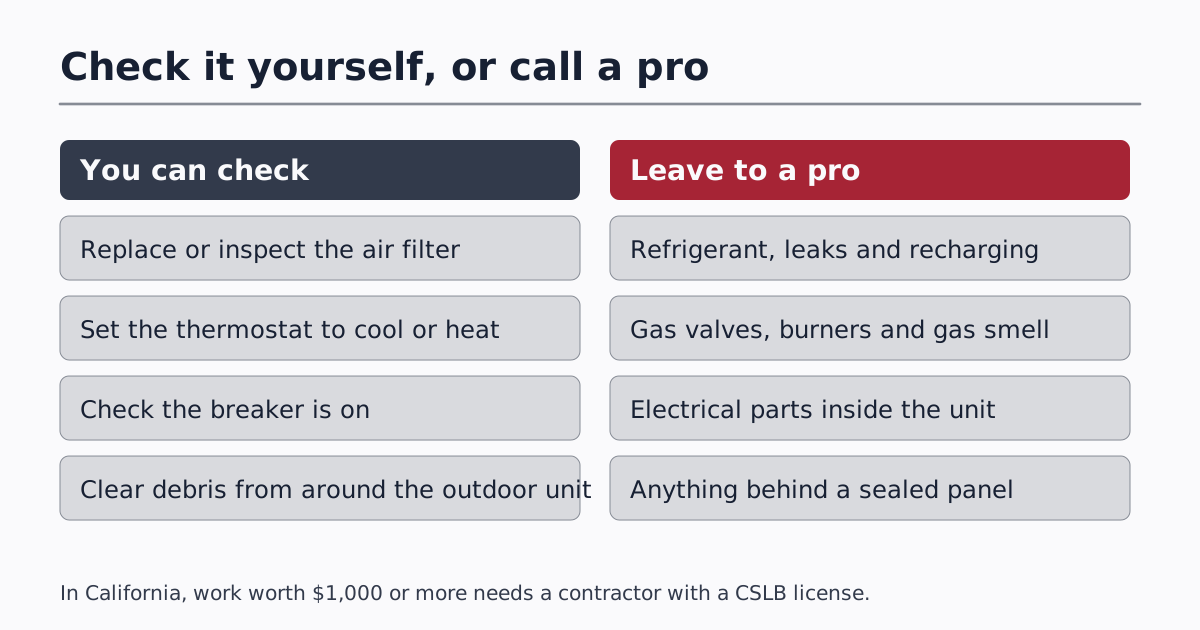
If your AC is blowing warm air, start with the simple things: thermostat set to cool and below room temperature, a clean filter, the breaker on, and nothing blocking the outdoor unit. If those are fine, the cause is most likely a frozen coil, low refrigerant or a failed electrical part, and all three need a specialist. The full branch on AC not cooling and freezing up covers the cold-coil side in more detail.
This matters in Modesto because summer is long and hot. Climate data for 1991 to 2020 puts the July average high at about 95 F, and from 2017 to 2026 Modesto logged between 12 and 45 days a year at or above 100 F, per Extreme Weather Watch (the 2026 count is incomplete). An air conditioner that stops cooling in that weather is a comfort problem first and a health problem for some households after that.
Why is my AC blowing warm air?
An AC blows warm air when something stops it from removing heat from your home. The usual causes are restricted airflow from a dirty filter or blocked vents, a frozen evaporator coil, low refrigerant from a leak, a failed condenser fan or an electrical part such as a capacitor or relay. Thermostat settings are the cheapest cause to rule out.
Here is how the causes tend to look from inside the house:
| What you notice | Likely area |
|---|---|
| Weak airflow, then warm air | Dirty filter, blocked return, frozen coil |
| Strong airflow but warm air | Outdoor unit not running, low refrigerant, electrical part |
| Outdoor unit silent or humming | Capacitor, contactor, or fan motor |
| Ice on the indoor coil or lines | Airflow problem or low refrigerant |
| Cool air at first, warm after a while | Freezing coil, or an overheating outdoor unit |
This is a guide, not a diagnosis. Two causes can produce the same symptom, so a specialist tests before replacing anything.
What can I check before calling anyone?
Check the thermostat, the filter, the breaker and the outdoor unit. These are the only parts a homeowner should touch, and they fix a share of warm-air calls. Do all four before paying for a visit, and write down what you saw so you can tell the specialist.
- Thermostat. Set it to cool, fan on auto, and a few degrees below the current room temperature. Replace the batteries if it has them. Keep the thermostat out of direct sun.
- Filter. A clogged filter blocks airflow and can freeze the coil. Carrier and Trane say to change filters every 1 to 3 months depending on filter quality. The steps are in how to change a furnace filter, and the same filter location usually serves the AC.
- Breaker and switch. Look at the breaker panel and the shutoff box near the outdoor unit. If a breaker has tripped, switch it off fully and back on once. If it trips again, stop and call a specialist.
- Outdoor unit. Clear leaves, weeds and debris from around it, and make sure nothing blocks the fan. Do not open the cabinet.
Also check that supply vents and returns are open and not covered by furniture or rugs.
Why is the outside AC unit blowing warm air or not running?
If the outdoor unit blows warm air, that is normal: it is releasing the heat pulled from your house. The real question is whether it is running at all. A silent outdoor unit with the indoor fan blowing usually points to an electrical problem, such as a failed capacitor or contactor, or to a tripped breaker.
Do not test capacitors yourself. Carrier says capacitor repair should typically be handled by a qualified HVAC professional because capacitors can hold a dangerous charge even when power is off. Fixr's AC repair guide (January 2026) lists capacitor replacement at $100 to $400, while a contactor or other electrical repair depends on the part and the labor, so ask for them on separate lines.
If the outdoor fan is not turning but the unit hums, switch the system off at the thermostat to avoid damage and call for a quote. Running a system with a failed fan or a locked compressor can make a small repair larger.
Can a frozen coil cause warm air?
Yes. When the indoor coil ices over, air cannot pass through it, so you get weak airflow that feels warm. Trane names restricted airflow as the biggest cause, from a clogged filter, blocked return vents or a dirty evaporator coil. Low refrigerant is the other main cause.
If you see ice on the coil or refrigerant lines:
- Switch the thermostat to off. Lennox says setting the fan to on can speed the thaw.
- Do not chip or scrape the ice. Trane warns that running a frozen coil can cause major damage.
- Replace the filter while it thaws.
- If it freezes again after airflow is restored, call a specialist, because the cause may be a refrigerant leak, blower motor or thermostat fault.
Water from a thawing coil can overflow the drain pan, so keep towels nearby and read about AC water leaking.
What does low refrigerant mean for warm air?
Low refrigerant means there is a leak. An air conditioner is a sealed system, and refrigerant is not used up in normal operation. Carrier states that low refrigerant is not a normal condition for a properly sealed AC system, so topping up without finding the leak only delays the same failure.
Refrigerant work is restricted by law. Under EPA Section 608, only technicians with EPA Section 608 certification may buy refrigerant for stationary air conditioning equipment, and knowingly venting it is prohibited. Fixr's AC repair guide (January 2026) lists refrigerant leak repair at $200 to $1,500 and a recharge at $100 to $600. Refrigerant is priced by the pound and varies by source, so the quote should show pounds and price per pound.
Newer equipment made after January 2025 uses different refrigerants. EPA's May 2026 final rule removed the January 1, 2026 installation deadline for most residential R-410A systems made before 2025, so check EPA's Technology Transitions page and local rules, and ask the specialist which refrigerant your unit uses before agreeing to a recharge.
Other versions of the same problem
People describe the problem in different ways. Each of these points back to the same causes above:
- Home, house or central AC blowing warm air: the same checks apply. Central systems have both an indoor and an outdoor part, so look at both.
- AC blowing luke warm air: often a partly frozen coil, a dirty filter or a system too small for a very hot day, which cools less as it runs.
- AC just blowing warm air and nothing else: the compressor or outdoor unit is probably not running.
- AC blowing warm air at idle: if warm air comes when the system is between cycles, that may be the fan running with no cooling. If it happens during a cooling call, treat it as a failure.
- AC blowing out warm air only some days: a failing capacitor or overheating outdoor unit can work in mild weather and quit in extreme heat.
How do I get a quote for a warm-air problem?
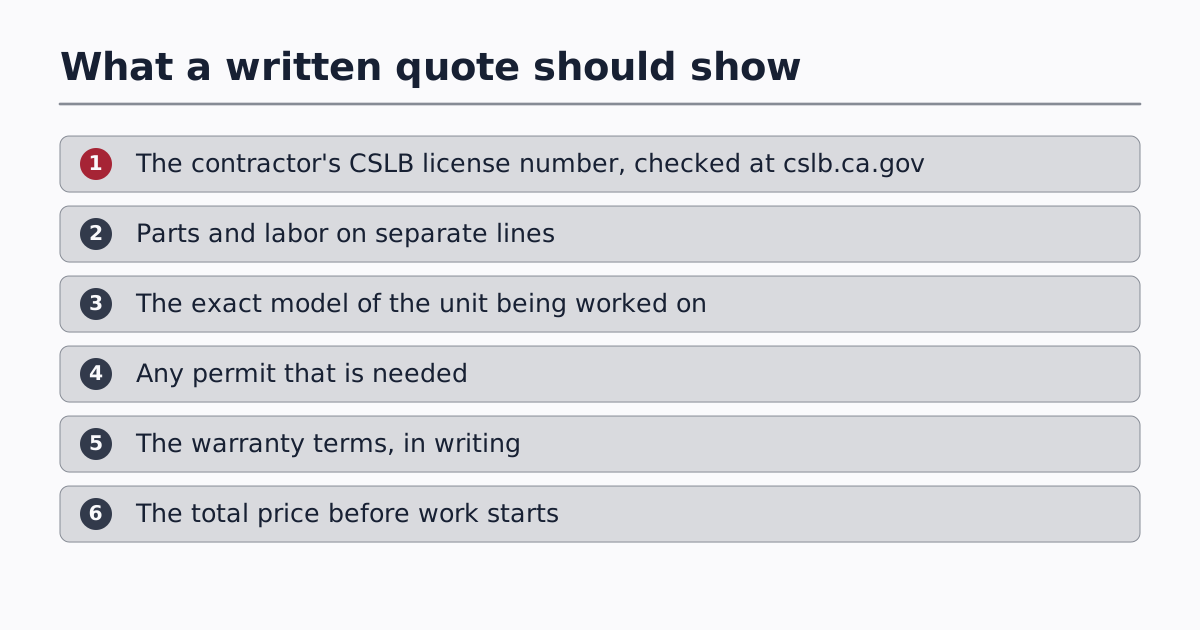
Describe what you checked and what you saw, including ice, noises and whether the outdoor unit runs, then ask for a written quote that separates the diagnostic fee from the repair. Fixr lists a diagnostic or service call at $75 to $250. Check each contractor's CSLB license at cslb.ca.gov.
Start a request on the price request page, and see the home page for other cooling and heating topics.
Questions people ask
How long does it take to fix an AC blowing warm air?
Simple fixes like a filter or breaker take minutes. A capacitor or contactor swap is often done in one visit. Refrigerant leaks, coil replacement or a compressor failure can take longer because parts may need ordering. Ask for a timeline in the written quote, especially during a heat wave.
What should I ask before I hire someone to fix an AC blowing warm air?
Ask for the CSLB license number and check it at cslb.ca.gov. Ask what the diagnostic fee covers, whether it comes off the repair, and what the part warranty is. If they suggest refrigerant, ask where the leak is and who is handling the refrigerant under EPA rules.
Do I need to be home when my AC is repaired?
Yes, an adult should be there at the start and end of the visit. You need to show the specialist the indoor and outdoor units, approve any change to the quote and confirm the air is cold before you pay.
Is it okay to keep running an AC that blows warm air?
Not for long. If the coil is frozen or the outdoor unit is not running, continued use can damage the compressor or blower. Switch the system off, let any ice melt, check the filter and call for a quote. Use fans, close the blinds and spend time in the coolest room to chill out while you wait.
Why is my AC not cooling but the fan is running?
The indoor fan can run without any cooling happening. That usually means the outdoor unit is off, the coil is frozen or refrigerant is low. Check the breaker and the filter. If both are fine, the problem is a repair, not a setting.
Sources
- Trane: evaporator coil is frozen
- Carrier: AC short cycling
- EPA Section 608 refrigerant sales restriction
- Fixr AC repair cost guide, published national cost guide, checked Nov 2026
Last updated