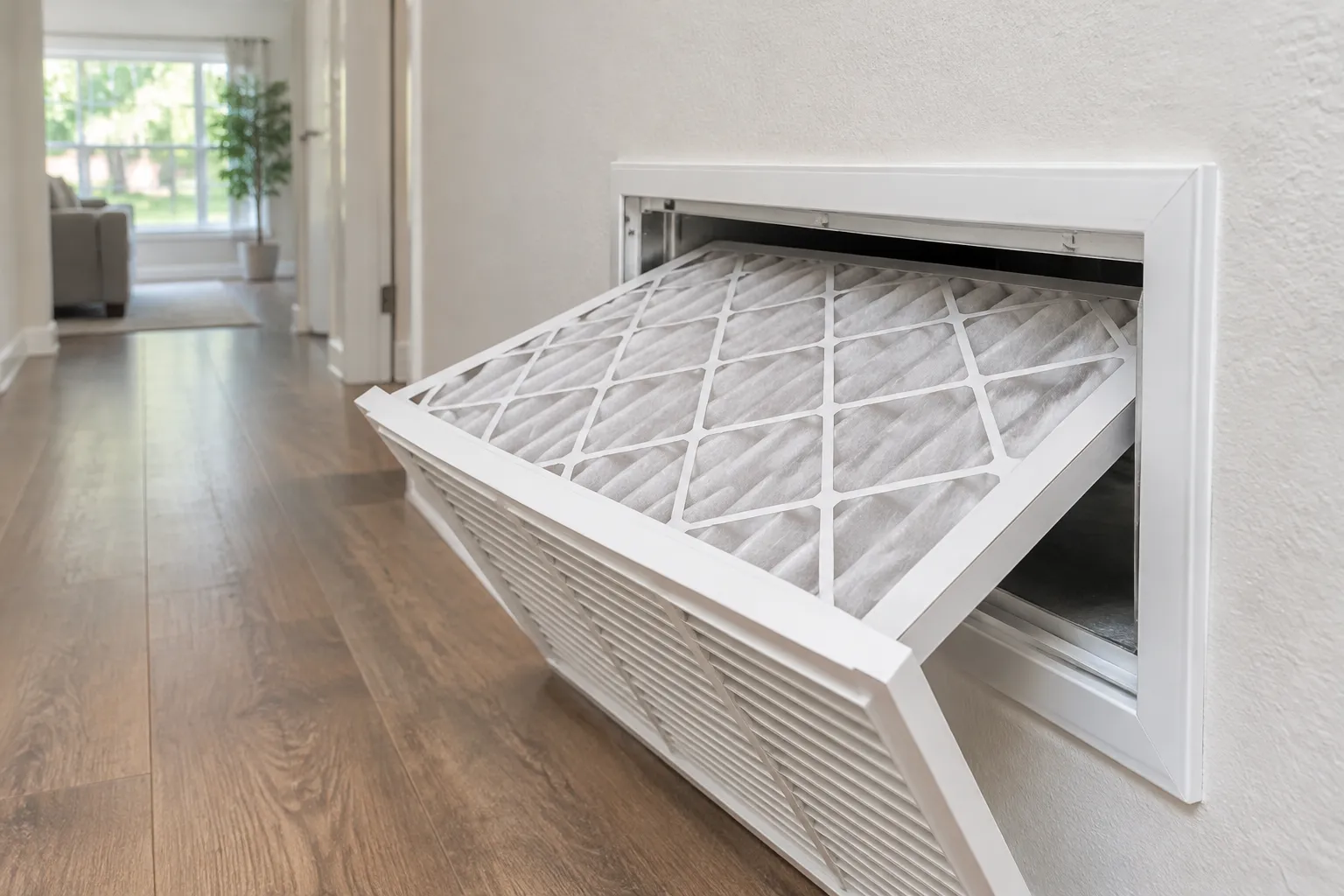
To change a furnace filter, switch the thermostat to off, find the filter slot, slide the old filter out, note its size and the arrow on its frame, then slide in a new filter with the arrow pointing toward the furnace. Turn the system back on. That is the whole job, and it is one of the few furnace tasks that is safe for a homeowner. The wider topic of furnace repair and replacement covers everything beyond it.
This page is the hands-on version: tools, steps, how to read filter sizes and MERV ratings, and what to do when the furnace still misbehaves. If you want to know how often to change it and which type suits Central Valley dust, smoke and heat, that has its own page on furnace air filter change frequency.
How do I change a furnace filter, step by step?
Turn the thermostat to off, find the filter, pull the old one out, and put a new one in with the airflow arrow pointing into the furnace or toward the blower. Check that it sits flat with no gaps, close the cover, and restart the system. Write the date on the frame.
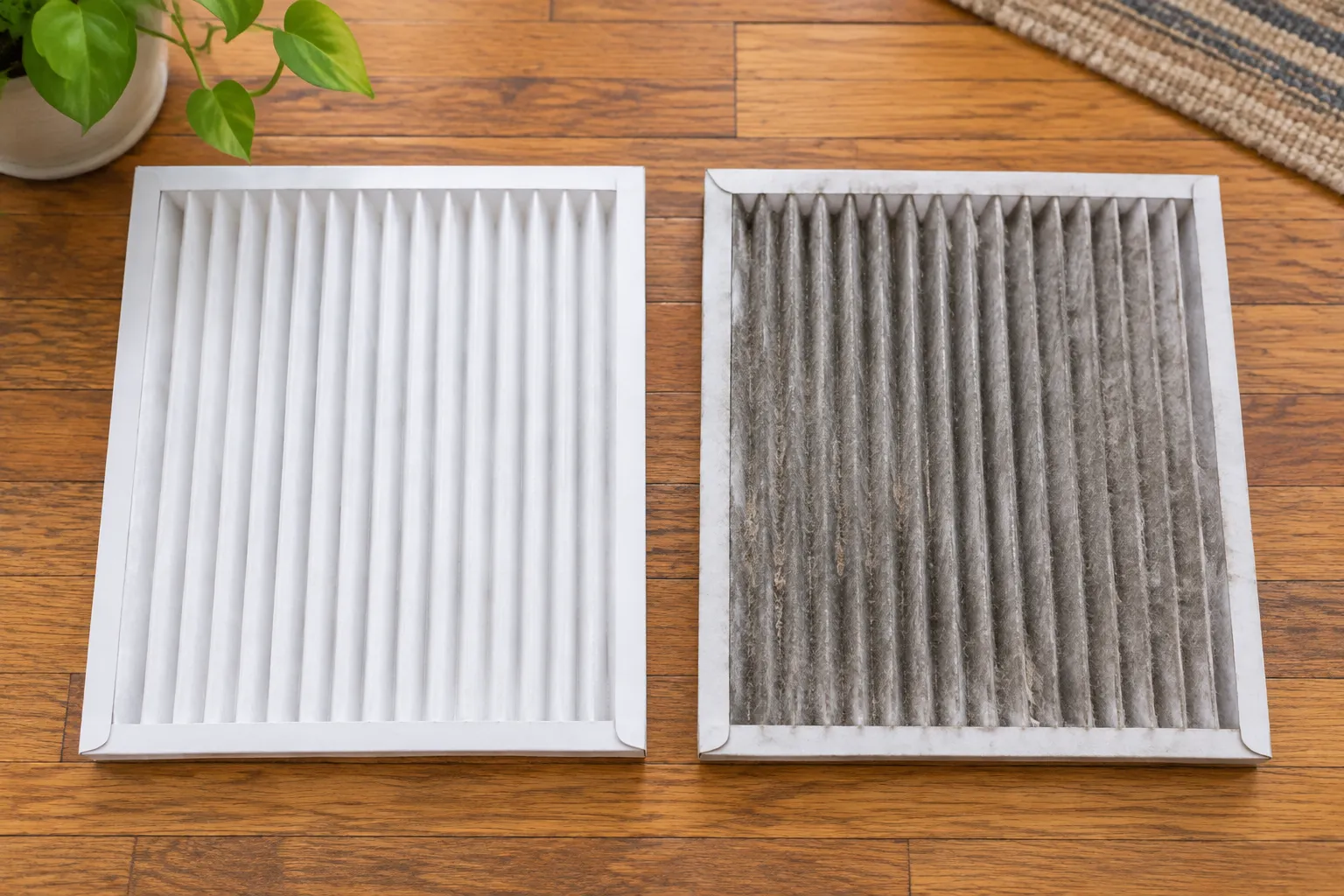
You do not need tools for most homes. Have the new filter, a flashlight and a trash bag ready.
- Switch the thermostat to off. Some people also turn the furnace switch off, which is a good habit if the filter slot is near the blower.
- Find the filter. It is in one of three common places: a slot in the side of the furnace cabinet, a return-air grille in a wall or ceiling, or a slot in the return duct next to the furnace.
- Open the cover. Most slots have a hinged door or a push-clip panel.
- Slide out the old filter. Notice which way the arrow on the frame points.
- Read the size printed on the frame edge (more below) before throwing it away.
- Slide in the new filter, arrow pointing toward the furnace and the blower, not toward the return grille.
- Close the cover firmly. A loose door lets unfiltered air in.
- Switch the system back on and check that air flows from the vents.
If the filter is wet, moldy or covered in something other than dust, do not just swap it. Call for a quote, because moisture around the furnace can point to a drain or humidity problem.
What size furnace filter do I need?
The size is printed on the edge of your current filter, in three numbers such as length by width by thickness in inches. Buy exactly that size. Filters that are too small leave gaps that let dust bypass the filter, and filters that are too large will not seat properly.
Printed sizes usually show a nominal size, which is the rounded name, and sometimes an actual size, which is slightly smaller. Either is fine as long as you match the nominal size on your current filter. Common formats you will see include 1 inch, 4 inch and 5 inch thicknesses, written like 20x25x1 or 20x25x5.
If the old filter has no printing, measure the slot, not the filter. Measure length, width and depth, then round to the nearest whole inch. A deeper media cabinet may take a thick filter, but you cannot force one into a slim slot.
What does the MERV rating mean?
MERV is a scale that shows how small the particles are that a filter can catch. A higher number catches smaller particles but also restricts airflow more. Pick the highest rating your furnace and blower are designed to handle, not the highest number on the shelf.
Check your furnace manual or the label for the maximum filter rating. If it does not say, a mid-range filter is a safe choice. A filter that is too restrictive can reduce airflow and make the furnace work harder, which hurts energy efficiency and raises energy bills. Carrier explains that restricted airflow can make a system overheat and shut down as a safety step.
A simple way to think about it:
- Low rating: basic protection for the equipment, lets more dust through, usually cheapest.
- Middle rating: a balance of cleaner air and airflow, a sensible default for most homes.
- High rating: catches finer particles, but needs a system and blower built for it.
If someone in the home has allergies or asthma, ask a specialist what rating your system can handle instead of guessing.
What safety rules apply when changing a filter?
Switch the system off before you open anything, never run the furnace with the filter slot open, and never reach past the filter slot into the cabinet. A filter change should not involve touching burners, wiring or gas parts. If something looks wrong inside, close the door and call a specialist.
Basic safety points:
- Do not remove other panels. Those are for specialists.
- Do not light anything near the furnace.
- Make sure carbon monoxide alarms are working. The CPSC recommends battery-operated or battery-backup alarms on every level and outside sleeping areas; test them as the manufacturer directs.
Furnaces can produce carbon monoxide if they are poorly maintained or have blocked venting. A filter change is not a substitute for a yearly inspection of fuel-burning heat.
How can I tell if my furnace is broken, not just clogged?
A clogged filter causes weak airflow, longer run times and sometimes shutdowns. A broken furnace usually shows more: no heat at all, a clicking or humming with no flame, a flash code on the board, or repeated lockouts. If a new filter does not change the symptom within a day, assume something else is wrong.
Signs that are filter-related:
- Weak airflow from every vent.
- The furnace runs a long time and the house barely warms.
- It shuts off and restarts on its own, and the filter is dark and clogged.
Signs that are not:
- The blower runs but air stays cold.
- You hear clicking, then silence.
- A burning smell that does not fade after a first-of-season start.
Industry troubleshooting guides describe an ignition sequence where the inducer, pressure switch, igniter, gas valve and flame all have to work in order. A fault in any of them can look like "no heat". That is a diagnosis for a specialist, not a filter change. See repairing a gas furnace for the causes and published cost ranges.
Where is the furnace reset button and should I press it?
Many furnaces do not have a labeled reset button you should use. Some have a small red or yellow button on the blower housing or a reset on the control board, and the location varies by model, so check your manual. Press a reset once at most. If it trips again, stop and call.
A furnace that shuts off and needs to be reset again and again is protecting itself. Common reasons include a clogged filter, restricted airflow or a failed ignition step. Many furnaces lock out after a few failed ignition tries and flash a code; check the manual for the count. Pressing reset repeatedly can hide a safety problem, including blocked venting.
Check, in order: filter, vents, thermostat, power. Then call. Do not open the furnace to look for a reset.
If you are asking "how to repair furnace" problems yourself, the honest answer is: filters, thermostat batteries and settings, and breaker checks are yours. Everything else belongs to a contractor who holds a CSLB license. Fixr's furnace repair guide (updated August 2025) lists a typical range of $349 to $650, with a flame sensor at $68 to $127 and an igniter at $96 to $178.
When is a new filter not enough?
If the furnace still short-cycles, blows cold, or lights and dies after a clean filter, the cause is not the filter. Get quotes from local specialists and check each contractor's license at cslb.ca.gov before work starts.
Start with the price request page. The home page covers other heating and cooling topics for Modesto and nearby towns.
Questions people ask
How long does it take to change a furnace filter?
About five minutes once you have the right size. Finding the slot the first time may take a little longer. Write the date and size on the frame or on a note near the furnace so next time is quicker.
What should I ask before I hire someone to change a furnace filter?
Most homes do not need to hire anyone for this. If you do, ask what the visit costs, whether the filter is included and what size and rating they are installing. If a specialist visits for another reason, ask them to show you the filter location and rating.
Do I need to be home when a furnace filter is changed?
If someone else does it, yes, someone should be there to show them the slot and check the size. If you do it yourself, there is no one to wait for. Just turn the thermostat off first.
Which way does the arrow on the filter point?
Toward the furnace and the blower, which is the direction air travels through the filter. If the arrow is backward the filter still fits, but it may not hold up as well. If you find an old filter in backward, flip the new one the right way.
Can I run the furnace without a filter?
No. Running without a filter lets dust into the blower and heat exchanger area and can shorten the life of parts. If you run out, put in the closest-fitting filter you can find until you buy the right one.
Sources
- Carrier: AC short cycling and filters
- CPSC carbon monoxide fact sheet
- Fixr furnace repair guide, published national cost guide, checked Nov 2026
Last updated